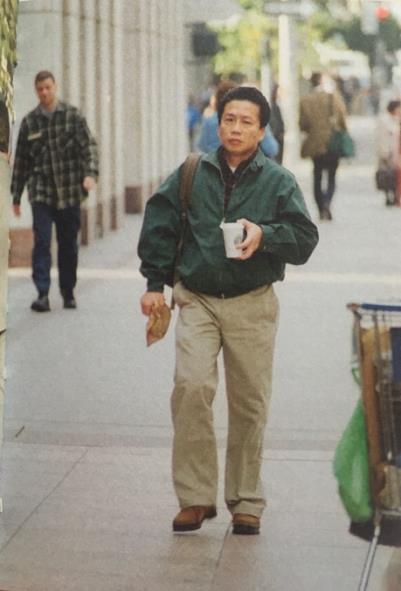
Nearly ten years ago, I came across this picture of a man walking down the street with a cup from Starbucks. It was a familiar scene. But at that moment I was fascinated to see something I hadn’t before—he was holding his cup between his thumb and middle finger. It is an ingenious way to hold a cup (presumably containing hot coffee), and yet I had never taken notice, because I did this often, too, without thinking.
This image is one of more than 100 snapshots collected in the book Thoughtless Acts?, written by members of the design consultancy IDEO. The company is known for its many innovations, including the creation of the computer mouse as we know it today. Each image in Thoughtless Acts? is a record of people interacting with their environment in creative ways. A runner props her foot up on the edge of a picnic table to tie her shoelace. A street musician performs inside a tunnel walkway, exploiting the space’s acoustic qualities. They provide insight into people’s desires and intuitive reactions—things that are difficult to uncover with traditional questionnaires or market research.
Such insight into people is important in creating good design that is enabling instead of confusing. As the cognitive scientist Donald Norman points out in his classic book, The Design of Everyday Things, so many of our errors are due to bad design. “When you have trouble with things—whether it’s figuring out whether to push or pull a door or the arbitrary vagaries of the modern computer and electronics industry—it’s not your fault. Don’t blame yourself: blame the designer.” Good design is frictionless for users, and to make that happen, observation of people is crucial. This was something I took to heart as I later studied graphic design and got a job in the field. It remains a central concept for designers today.
For me, that unremarkable scene of a morning commute was associated with a fresh set of eyes with which to see the world. However, as I strived to maintain such an inquisitive stance in my life, I began to question whether user-friendliness was the only virtue. There are so many aspects in the lifetime of a product that don’t involve the user, such as planning, procurement, production, logistics, sales, storage, maintenance, disposal, and recycling. I wondered if, as a user myself, I was losing touch with the wellbeing of the people involved in those stages. I also wondered about the universe beyond our short-term activities—the ecosystem—that support our existence in the first place. I wanted to see the complete picture of a designer’s work.
Indeed, such concerns are being voiced in parts of the design community. In his 2016 article titled “Design as Participation,” the designer and entrepreneur Kevin Slavin examines the user-centered tradition. While acknowledging the positive aspects of this principle, he argues that “[t]he lens of the user obscures the view of the ecosystems it affects” (ecosystems here meaning social systems as well as natural ones). The writer Robin Sloan, who is quoted in Slavin’s article, warns of “the Amazon move: absolute obfuscation of labor and logistics behind a friendly buy button.” We can enjoy all kinds of products and services at the click of a button on a sleek website. In other words, we forget by design that there is a world beyond that button.
Today, despite the many social changes seen in the past decade, the above photo still represents business as usual. It might even symbolize life gone back to normal after the coronavirus pandemic. But when I look at the image I cannot help but come up with a number of questions. Who are growing the coffee beans (or the tea leaves)? And how? Where did the oil that made the plastic lid come from? What about the energy for lining the cups with plastic? Where will the lid go a few hours later, and after it’s collected the next morning? Will it end up in landfill, after going through an incinerator and releasing CO2? How much energy and local tax money go into collecting and processing the product-turned-waste? How long will it take for the items to return to the soil? (Or will they ever?)
Such questions would be enough to ruin any coffee break, but as a designer and a user, I wouldn’t want to suppress these questions either. The world could be disproportionately optimized around users at the moment, but that means we also have the power to shift that attention outwards. And in order to exercise that power, it would help to look again—not only closer, but also deeper.
 Ai Tomiki